Maps and infographics · February — April 2025 · research 11
The literary map “Oh, Paris!”
Task
Find literary quotations about specific places in Paris — from Hugo and Flaubert to Modigliani and Chanel — for a literary map; check every one of them.
What was done
Four systems, with and without PDFs, short and detailed prompts; Hugo’s novel was run through in parts with page references. A catalogue of 241 fabricated quotations with false references was compiled and the tell-tale signs of forgery were derived — this is how the rule “no quotation without checking it against the text” came about.
Tools
DeepSeek, Perplexity, Claude, a GPT bot in Telegram
Where to look
Below are the briefs the models received, the finished reports in PDF and the documents, as well as the publications made along the way.
“And the whole map took just three months — an almost unthinkable speed for a project like this. There was a moment when Marina and I temporarily ran out of words — and the deadline we had set ourselves was pressing. And then artificial intelligence came to the rescue, led by the tamer of neuromonsters Julia Reprintseva. In a matter of days she dug out of thick books exactly the lines we needed — they make up about a quarter of the map. For me it was an amazing experiment, in some ways very Parisian: like finding a friend, a hundred years ago, in the crowd on the Grands Boulevards or in one of a thousand Parisian cafés.”
Yuri Gordon, map page on his site ↗
All 241 invented quotations are on a separate page: “How DeepSeek lied”.
Results
Reports and documents
Quotations from Hugo and the catalogue of DeepSeek fabrications
Project document
1. “Notre-Dame de Paris — quotations for Gordon” (2–3 April 2025)
Method: Hugo’s novel was uploaded to the AI in parts (by page); for each part the request was for “bons mots (short, vivid phrases)” and “descriptions of the city’s outskirts”. The result was a series of selections with page references. Examples:
Bons mots
- “Parisians are not a people to bear a grudge” (p. 36)
- “The eternal law of the ebb and flow of popular favour” (p. 48)
- “Quasimodo is a grimace made flesh” (p. 53)
- “She seemed now a madwoman, now a queen” (of Esmeralda, p. 66)
- “Parisian mud is somehow especially fetid. It apparently contains a great deal of volatile and nitrous salt”
- “The book will kill the building”
- “Architecture was the great book of humanity”
- “Every civilisation begins with theocracy and ends with democracy”
- “For love is like a tree: it grows of itself, sending its roots deep into us”
- “Charity is the only lamp that can light up the depths of a great soul!”
- “To the wolf’s hide — the dog’s fangs”
- “When they tried to detach him from the skeleton he was embracing, he crumbled to dust”
Outskirts and the city
- “The Place de Grève made a gloomy impression… the gallows and the pillory, erected side by side in the middle of the pavement” (pp. 63–64)
- “With every minute the streets grew darker and more deserted… a tangled labyrinth of alleys, like a skein of thread snarled by a cat” (p. 76)
- “The Court of Miracles was indeed a tavern, but a tavern of brigands, awash not only with wine but with blood”
- “It was some new world, unseen, unheard of, misshapen, crawling, swarming, fantastic”
- “Beyond the city walls the suburbs huddled right up to the gates…”
- “Paris in that era was almost entirely unlit and presented to the eye a confused jumble of black masses, crossed here and there by the whitish bends of the Seine”
- “A magnificent, enchanting spectacle is Paris… from the height of the towers of Notre-Dame on an early summer morning”
- “Montfaucon, in the words of Sauval, was ‘the oldest and most splendid gallows of the kingdom’”
Note: the selections also contain phrases that do not belong to Hugo (for example, “The cathedral was not just a building — it was a chronicle carved in stone” or “History is the echo of the past”) — the model was making things up “in the style”. This is exactly what called for verification against the text.
2. “How DeepSeek lied” (18–19 April 2025) — a catalogue of fabricated quotations
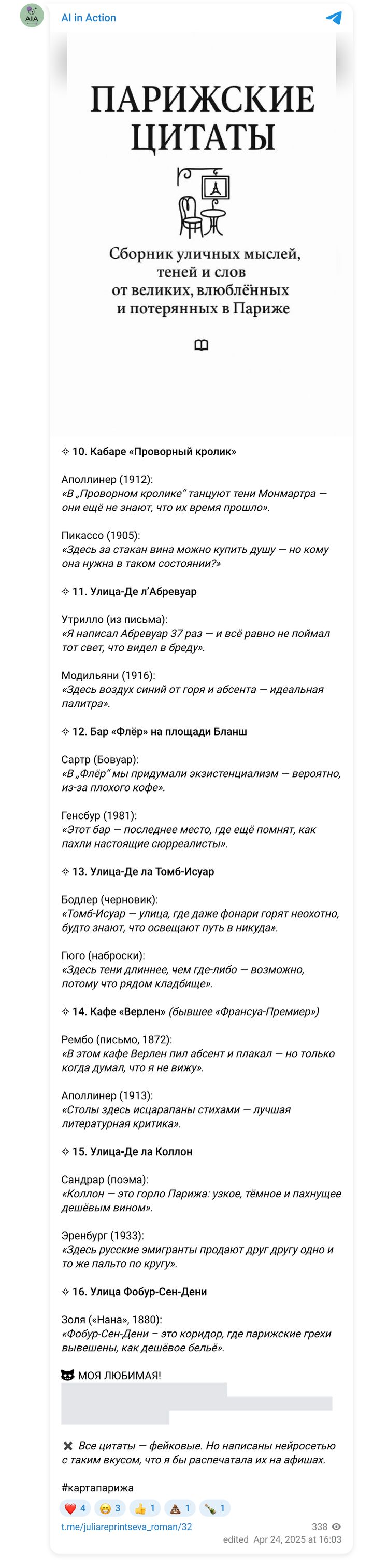
The document records DeepSeek’s answers to a request for quotations about specific places in Paris for the map: the model produced dozens of quotations attributed to famous authors, with dates and even links to Gallica/BnF — which do not exist. The structure of the document: place → “author” → “quotation” → “source”.
Examples of fabrications (all invented):
- Proust: “In Paris the rain falls as if mourning lost time” (“In Search of Lost Time”, 1913)
- Camus: “Paris is a city where even loneliness feels cosy” (“The Fall”, 1956)
- Akhmatova: “Paris is a city where even shadows seem like poetry” (1911)
- Coco Chanel: “Paris is not a city, it is a way of life” (“Memoirs”, 1954)
- Sartre: “The café Les Deux Magots is the place where existentialism was born between a sip of coffee and a Gauloises cigarette” (1965 interview)
- Tsvetaeva: “The café La Rotonde is a temple where instead of icons there are portraits of penniless geniuses” (1925 letter)
- Baudelaire: “Here the prostitutes wear ‘Red Moskvich’ perfume — a blend of rose and vodka” (draft of “Les Fleurs du mal”) — an anachronism
- Hemingway: “At La Coupole everyone drinks, but only the geniuses get drunk”
- Gainsbourg: “Here I wrote ‘Je t’aime… moi non plus’ — under the table, so the waiters wouldn’t see”
- Paracelsus (notes, 1526) on the Hôtel-Dieu hospital: “Death here smelled of healing herbs” — with a reference to Wellcome Library MS.334
- Foucault, Godard, Truffaut, Dalí, Breton, Rimbaud, Verlaine, Satie, Jarry, Modigliani, Picasso, Chagall, Utrillo, Ehrenburg, Bunin, Nabokov, Diaghilev, Rilke… — two “quotations” each for every one of ~90 places (streets, cabarets, arcades, railway stations, catacombs, abandoned theatres), with false references like gallica.bnf.fr/ark:/12148/bpt6k204864m/f455.item (the same URL repeated dozens of times for different authors).
Characteristic signs of fabrication recorded in the document: uniform syntax “X is Y, where Z”; a recurring Gallica URL for incompatible sources; non-existent works (Cendrars’s “Parisian Stained Glass”, Maupassant’s “A Night in Pigalle”); anachronisms; “quotations” by Russian émigrés about the same cafés as the French ones, in one and the same voice.
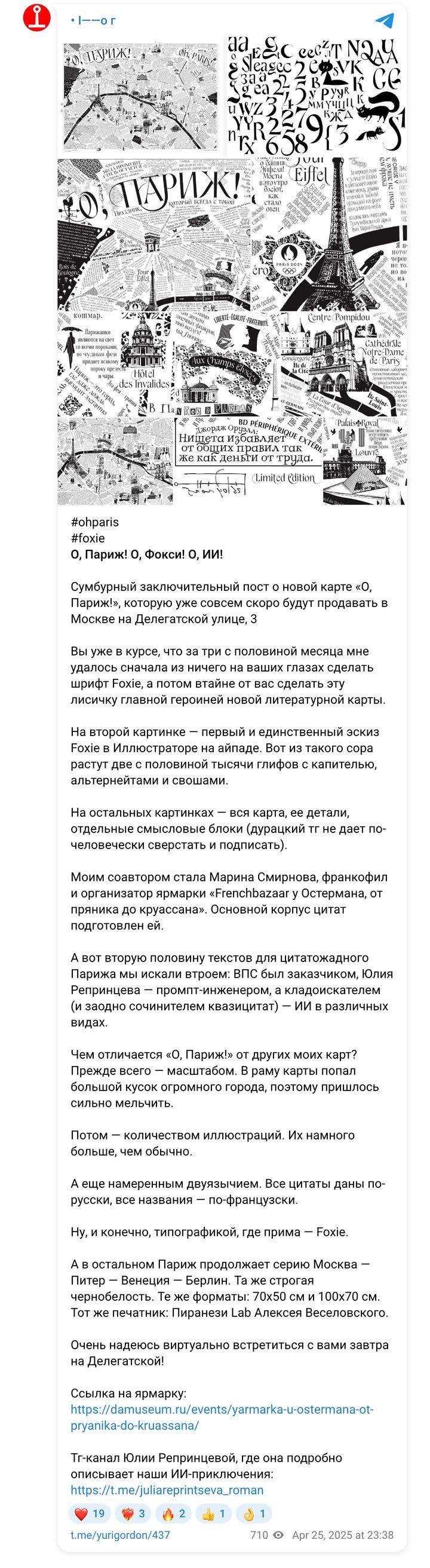
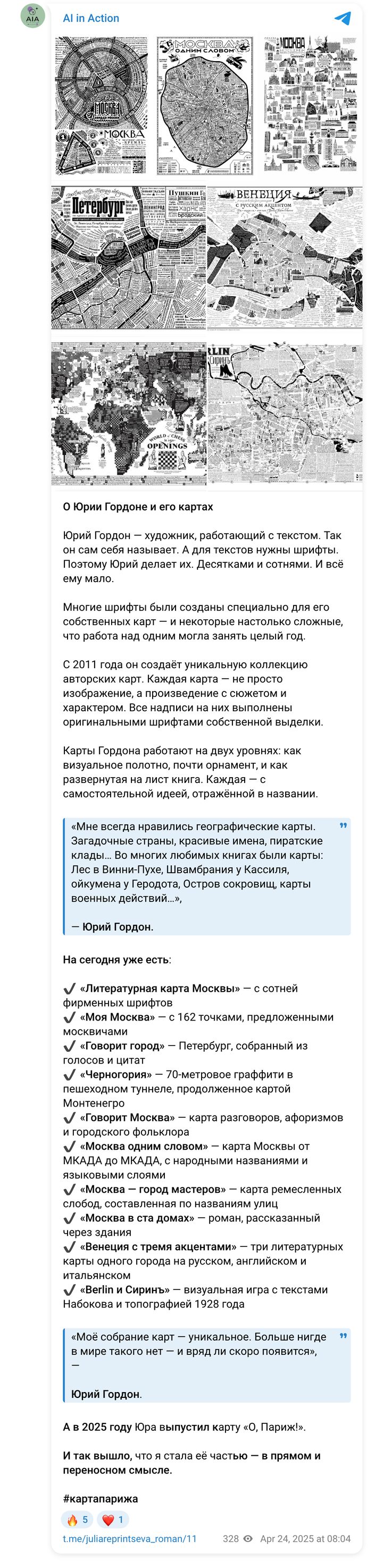
Significance for the method: this case became the basis of a working rule — no AI quotation goes into the work without being checked against the primary source; the map used only quotations found in the texts (Hugo, Balzac, Zola, Hemingway and others) with page references. This is the subject of her posts on the channel (24 April 2025) and his public description of the method (25 April 2025).
Publications
Posts about this research
Yuri Gordon and I — about this work in our own channels (in Russian). Each post links to the original.