The book “Letters of the 20th Century” · May — June 2026 · research 10
From daisy to bear: the visual communication of Festival-57 and the 1980 Olympics
Task
“Let me pitch the idea and you turn it into a prompt”: describe and compare the design of the 1957 Youth Festival and the 1980 Olympics, and set them against Western design of the same years; both deep research and a digest were needed.
What was done
A series of six briefs and six Deep Research runs: Soviet mass festivities, Olympic design systems 1968–1980, World Cups, an annotated base of Western sources — and a single analytical chapter built on them. Yuri Gordon called the final base the best thing AI had done for his book.
Tools
ChatGPT Deep Research
Where to look
Below are the briefs the models received, the finished reports in PDF and the documents, as well as the publications made as the work went along.
Briefs
What exactly the model received
Brief: a single analytical chapter from six reports
My document · the text the model received · 21 May 2026
Based on the attached research reports, prepare a single analytical chapter / paper on the topic:
The Festival and the Olympics as two design events: from the Soviet mass festivity to international event branding
Task
Bring the results of several studies together into a coherent, logical, well-structured text.
The main idea to be tested and developed:
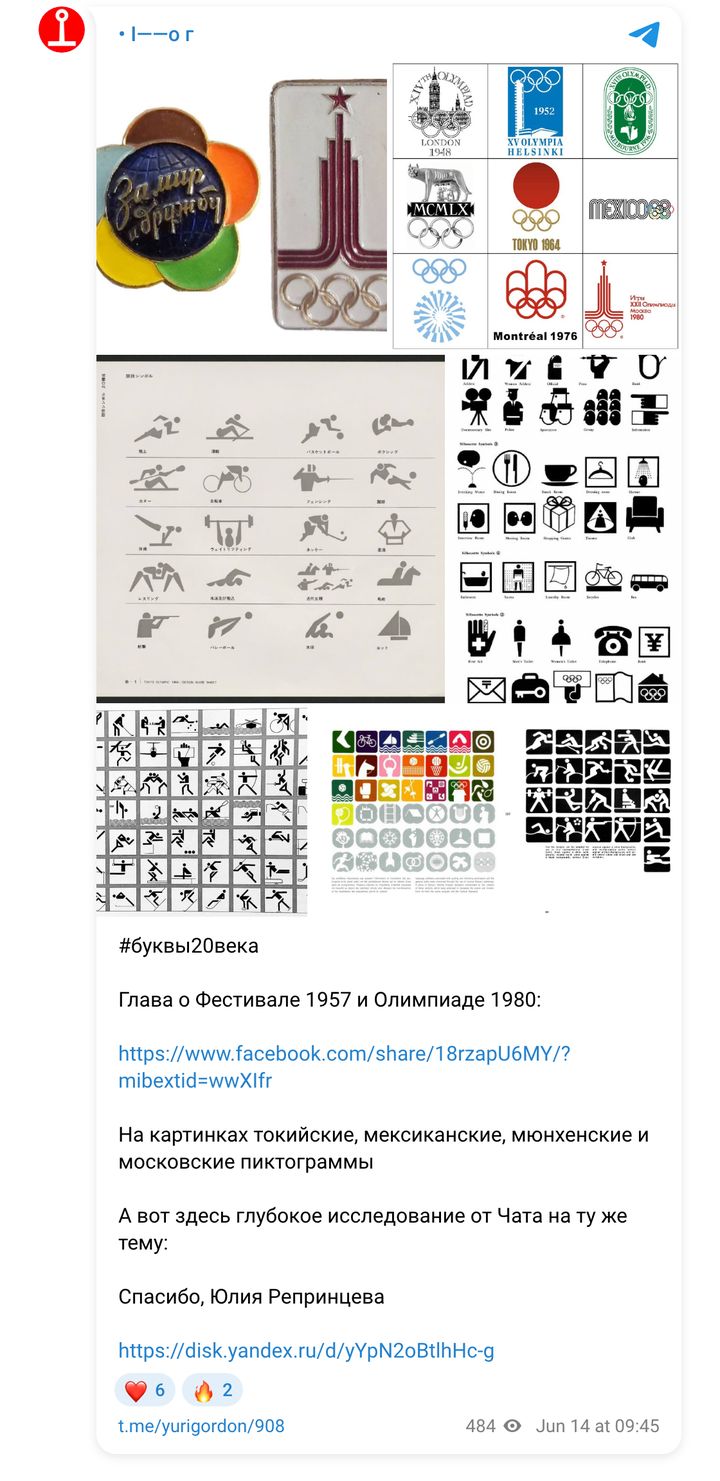
The 1957 World Festival of Youth and Students and the 1980 Moscow Olympics can be seen as two points in the development of Soviet design for an international event. The 1957 Festival is tied to Thaw-era festivity, youth, peace, the USSR opening up to the world and the decorative dressing of the city. Olympics-80 shows a more mature, systematic and institutional form of event branding, in which the Soviet tradition of the mass festivity merges with international Olympic standards, wayfinding, pictograms, a mascot, souvenirs and the television picture.
Structure of the text
- Introduction:
- why the 1957 Festival and Olympics-80 can be compared as design events;
- why this is not just “decoration” but a visual system of the state.
- The 1957 Festival:
- historical context;
- visual language;
- emblem;
- dressing of the city;
- parade and ceremonies;
- the image of Moscow and the USSR.
- Olympics-80:
- historical context;
- emblem;
- Misha;
- posters;
- pictograms;
- wayfinding;
- urban environment;
- opening ceremony;
- made-for-television quality.
- Comparing the two Soviet events:
- from festival decorativeness to the Olympic system;
- from Thaw internationalism to late-Soviet state branding;
- from the city as festivity to the city as infrastructure;
- from the poster and the banner to a comprehensive visual programme.
- Western context:
- Mexico-68;
- Munich-72;
- Montreal-76;
- Moscow-80;
- how the Soviet approach differed from Western modernist design.
- Soviet festivities and Olympic ceremonial:
- parades;
- demonstrations;
- physical-culture festivals;
- mass formations;
- the stadium as a stage;
- the city as ideological scenery.
- Typography, pictograms and wayfinding:
- compare Western systematicity and Soviet hybridity;
- show where Moscow-80 came close to the international standard;
- show where it kept the Soviet visual language.
- Conclusion:
- what these two events show about the development of Soviet design;
- why Olympics-80 was not just a sporting event but the culmination of Soviet visual design on an international scale;
- which questions require further archival research.
Style
Write it as a research text for a book, a lecture or an exhibition catalogue:
- clearly;
- analytically;
- without bureaucratese;
- with specific visual details;
- with cautious wording where the sources are incomplete;
- with proper dramaturgy, so that the text can be read, not just chewed through like archival cotton wool.
Required elements
- A comparative table Festival-1957 / Olympics-80.
- A comparative table Moscow-80 / Munich-72.
- A chronology 1948–1980.
- A list of visual materials for illustrations.
- A list of sources.
- A separate block “gaps in the research”: what could not be confirmed and where to look further.
Brief: Soviet mass festivities, parades and mega-events
My document · the text the model received · 21 May 2026
Conduct deep research on the topic:
Soviet mass festivities, parades and sporting mega-events: visual organisation, ceremonies and the urban environment
Aim of the research
Compare the visual and scripted organisation of Soviet mass festivities with the design and ceremonies of the Olympic Games and the football World Cups of the mid-20th century.
The main task is to understand which elements of Soviet festive culture were carried over into the design of the 1957 World Festival of Youth and Students and the 1980 Moscow Olympics, and which elements came from international sporting event branding.
Main research questions
- How was the Soviet culture of the mass festivity organised?
- Which visual elements are characteristic of Soviet parades, demonstrations, Spartakiads and festivals?
- How were the following decorated:
- Red Square;
- stadiums;
- streets;
- façades;
- reviewing stands;
- columns of demonstrators;
- temporary festive structures?
- How did the Soviet tradition of mass spectacle influence:
- the 1957 World Festival of Youth and Students;
- Olympics-80;
- opening ceremonies;
- the dressing of the city;
- posters and slogans?
- How did the Soviet festive model differ from Western Olympic ceremonies?
- Which elements were shared:
- the parade of participants;
- flags;
- symbolic figures;
- mass formations;
- stadium choreography;
- music;
- theatricalisation;
- the image of peace and friendship?
- How did television change the visual organisation of sporting mega-events?
Phenomena to compare
Soviet tradition
- May Day demonstrations;
- 7 November parades;
- physical-culture parades;
- Spartakiads;
- youth festivals;
- mass stadium performances;
- the decoration of Moscow for state holidays.
International sporting events
- the Olympics of 1952–1980;
- Mexico-68;
- Munich-72;
- Montreal-76;
- Moscow-80;
- the football World Cups of 1966–1982.
What to analyse
- Space:
- the city;
- the square;
- the stadium;
- the procession route;
- the reviewing stand;
- the façade.
- The body:
- the collective body;
- athletes;
- youth;
- delegations;
- mass formations.
- The sign:
- flag;
- banner;
- emblem;
- slogan;
- pictogram;
- coat of arms;
- the Olympic rings.
- The script:
- order of the procession;
- entry of the delegations;
- climax;
- final image;
- musical accompaniment;
- working with emotion.
- Media:
- photography;
- newsreel;
- television;
- international broadcasting.
Sources
Use:
- studies of Soviet mass festivities;
- materials on physical-culture parades;
- archival photos and newsreels;
- official Olympic reports;
- studies of Olympic opening ceremonies;
- work in visual culture, performance studies, Soviet studies;
- Russian- and English-language sources.
Output format
Produce a report with the following structure:
- Brief summary.
- A historical overview of Soviet mass festive culture.
- A table of the visual elements of the Soviet festivity.
- A comparison of the Soviet parade and the Olympic opening ceremony.
- A comparison of the 1957 Festival and Olympics-80 with Soviet festivities.
- A comparison with Western Olympic ceremonies.
- Section: “The stadium as political theatre”.
- Section: “The city as the scenery of the state”.
- Section: “The collective body and the international order”.
- Conclusions: what in Olympics-80 was Soviet, what was international, what was hybrid.
- Bibliography and links.
Important
Do not reduce the Soviet festivity to propaganda alone. Treat it as a complex system of visual management of space, the body, emotion, collectivity and the international image of the state.
Brief: the Moscow Olympics and Western design systems
My document · the text the model received · 21 May 2026
Conduct deep research on the topic:
The 1980 Moscow Olympics and Western Olympic design systems of 1968–1980: a comparative analysis
Aim of the research
Compare the visual system of the Moscow Olympics-80 with Western Olympic design systems of the same period, especially with the 1972 Munich Olympics.
The main focus is to understand how the Soviet approach to Olympic design differed from the Western modernist approach and in what ways they were alike.
Main cases for comparison
Be sure to cover:
- Mexico-1968.
- Munich-1972.
- Montreal-1976.
- Moscow-1980.
Pay special attention to Munich-1972 as the key example of systematic modernist Olympic design.
Main research questions
- How was the design system of the 1972 Munich Olympics organised?
- What role did Otl Aicher, the Ulm School, the modernist grid, the pictograms and the colour system play?
- How did the design of Munich-72 influence subsequent Olympic identities?
- In what ways did the Moscow Olympics-80 continue the international Olympic tradition?
- In what ways did Moscow-80 differ from the Western approach?
- How did the following differ:
- emblems;
- pictograms;
- typography;
- wayfinding;
- posters;
- colour systems;
- mascots;
- the dressing of the city;
- opening ceremonies;
- souvenirs and publications?
- Can Olympics-80 be considered a full design system in the Western sense?
- How did political contexts affect the design: the Cold War, the boycott of Olympics-80, the image of the host country, television?
What needs to be compared in detail
1. Emblems
- Mexico-68;
- Munich-72;
- Montreal-76;
- Moscow-80.
Analyse:
- geometry;
- links to national symbols;
- links to Olympic symbols;
- modernist / decorative / ideological logic.
2. Pictograms
Compare the sports pictograms of:
- Mexico-68;
- Munich-72;
- Montreal-76;
- Moscow-80.
Assess separately:
- the degree of systematicity;
- legibility;
- modularity;
- the link with the human figure;
- use in wayfinding and printed materials.
3. Wayfinding
Compare:
- wayfinding;
- signposts;
- maps;
- transport diagrams;
- multilingual solutions;
- stadium and city wayfinding.
4. Typography
Compare:
- the typefaces used;
- layout principles;
- grids;
- the hierarchy of information;
- Latin and Cyrillic;
- the balance of decorativeness and functionality.
5. Posters and visual communication
Compare:
- official posters;
- sports posters;
- cultural posters;
- tourist and advertising materials;
- souvenirs.
6. Urban environment
Compare how design went beyond paper:
- stadiums;
- streets;
- airports;
- hotels;
- media centres;
- transport;
- city decorations.
Sources
Use:
- Olympic World Library;
- the official reports of the organising committees of the 1968, 1972, 1976 and 1980 Olympics;
- The Olympic Design, Olympic Games visual identity sources;
- archives on Otl Aicher and Munich-72;
- studies of Mexico-68;
- studies of the Soviet design of Olympics-80;
- museum poster collections;
- catalogues of MoMA, the Design Museum, the V&A, Cooper Hewitt, if available;
- Russian- and English-language sources.
Output format
Produce a report with the following structure:
- Executive summary of 700–1000 words.
- A brief chronology of Olympic design systems 1968–1980.
- Separate profiles:
- Mexico-68;
- Munich-72;
- Montreal-76;
- Moscow-80.
- A large comparative table by parameter:
- emblem;
- pictograms;
- typography;
- colour;
- wayfinding;
- posters;
- mascot;
- urban environment;
- opening ceremony;
- the ideological image of the country.
- A separate section: “Munich-72 as the benchmark of the modernist Olympic system”.
- A separate section: “Moscow-80: between the international Olympic standard and Soviet festive culture”.
- Conclusion: how the Soviet model of event branding differed from the Western one.
- A list of visual materials to be found for illustrations.
- Bibliography and links.
Important
Do not draw conclusions at the level of “the West — functionality, the USSR — ideology”. That is too crude. The picture needs to be more complex:
- where Soviet design was systematic;
- where it was decorative;
- where it followed international standards;
- where it kept the logic of the Soviet mass festivity;
- where Western design was also political and representational.
Brief: Olympics and World Cups as design events
My document · the text the model received · 21 May 2026
Conduct deep research on the topic:
The Olympics and the football World Cups as global design events of the mid-20th century
Aim of the research
Understand how, in the mid-20th century, the Olympic Games and the football World Cups turned from sporting competitions into complex design events: with emblems, posters, wayfinding, ceremonies, an urban environment, souvenirs, a television picture and international branding.
Separately, find out when and how the USSR joined the Olympic movement and the football World Cups.
Time frame
Main period: 1948–1980.
Special focus:
- 1952 — the USSR’s first participation in the Summer Olympic Games;
- 1956 — the USSR team’s first participation in the football World Cup? Check the exact date and context;
- 1968–1980 — the period of mature visual systems of sporting mega-events.
Check all dates against reliable sources.
Main research questions
- When did the Olympics become full-fledged design events?
- When did stable branding elements appear in Olympic design:
- an official emblem;
- an official poster;
- pictograms;
- wayfinding;
- a mascot;
- a colour system;
- souvenirs;
- television graphics?
- How did the design of the football World Cups develop over the same period?
- When did the USSR first take part:
- in the Summer Olympic Games;
- in the Winter Olympic Games;
- in the football World Cups;
- in major international sporting ceremonies as a visually represented country?
- How did the opening ceremonies of the Olympics and World Cups change?
- How did sporting mega-events become an instrument of national image?
- How did Western, socialist and neutral/postcolonial visual strategies differ?
Events to analyse
Be sure to cover:
Olympics
- London-1948;
- Helsinki-1952;
- Melbourne-1956;
- Rome-1960;
- Tokyo-1964;
- Mexico-1968;
- Munich-1972;
- Montreal-1976;
- Moscow-1980.
Football World Cups
Cover the key tournaments of 1950–1982:
- Brazil-1950;
- Switzerland-1954;
- Sweden-1958;
- Chile-1962;
- England-1966;
- Mexico-1970;
- West Germany-1974;
- Argentina-1978;
- Spain-1982.
Look especially closely at:
- emblems;
- posters;
- mascots;
- the city and stadium environment;
- opening ceremonies;
- television presentation.
What needs to be found out separately
- When the USSR joined the Olympic movement after the Second World War.
- When the USSR began taking part in the football World Cups.
- How Soviet athletes and Soviet symbols were represented visually at international sporting events.
- How Soviet sports festivals and Spartakiads related to Olympic aesthetics.
Sources
Use:
- Olympic World Library;
- official Olympic reports;
- FIFA archives;
- official World Cup materials;
- museum collections of sports posters;
- studies of the history of Olympic design;
- studies of the history of football design;
- academic texts on sport, national image and visual culture;
- Russian- and English-language sources.
Output format
Produce a report with the following structure:
- Brief summary.
- Chronology 1948–1980: how sport becomes a design event.
- A table of the Olympics:
- year;
- city;
- emblem;
- poster;
- pictograms;
- wayfinding;
- mascot;
- features of the opening ceremony;
- features of the city decoration.
- A table of the World Cups:
- year;
- country;
- emblem;
- poster;
- mascot;
- features of the ceremony;
- features of the visual language.
- A separate section: “The USSR’s entry into the international sporting visual order”.
- A separate section: “When a sporting event becomes a brand”.
- Conclusions on the development of event branding in sport.
- A list of important visual materials for further analysis.
- Bibliography and links.
Important
Check the dates and make no assumptions without sources. If there is little data on wayfinding and city decoration for the World Cups, state the gaps openly.
Results
Reports and documents
- PDFThe Festival and the Olympics as two design events: from the Soviet mass festivity to international event branding (in Russian)1.8 MB
- PDFThe 1957 Youth Festival and the 1980 Olympics as two Soviet design events (in Russian)81 KB
- PDFThe Moscow Olympics and Western Olympic design systems of late modernism (in Russian)121 KB
- PDFThe Olympics and the football World Cups as global design events of the mid-20th century (in Russian)163 KB
- PDFSoviet mass festivities, parades and sporting mega-events of the mid-20th century (in Russian)79 KB
- PDFAn annotated base of Western sources on the graphic design of the 20th-century Olympic Games (in Russian)203 KB
Publications
Posts about this research
Yuri Gordon and I — about this work in our own channels (in Russian). Each post links to the original.