The book “Letters of the 20th Century” · February 2026 · research 06
Soviet monumental propaganda: from canvas to concrete
Task
Trace the evolution of monumental propaganda — parade décor, demonstrations, permanent structures — from 1917 to 1991: ideology, slogans, typography, materials; gather maximum visual material.
What was done
One working day: 11:55 the task → 12:05 a framework in Perplexity → 12:10 the brief in the prompt-building project → 13:00 Gemini’s report → 14:01 the final document and PDF. Three systems, three reports.
Tools
Perplexity, ChatGPT Deep Research, Gemini Deep Research
Where to look
Below are the briefs the models received, the finished reports in PDF and the documents, as well as the publications made along the way.
Briefs
What exactly the model received
Deep Research brief: monumental propaganda
My document · working project document · 5 February 2026
Topic: Monumental propaganda and mass festive decoration in the USSR (1917–1991) — visual media, typography, slogans, materials, bodies of sources.
The model’s role
You are a researcher of Soviet visual culture and an archival analyst. Your goal is to collect, verify and systematise the maximum of visual sources (photos, diagrams, publications, spreads, catalogues), not to retell general knowledge. Work as the author of a scholarly catalogue and a research dossier.
Research goal
- Build a research framework for the topic (periodisation, types of objects, key visual corpora).
- Collect and describe the core of visual sources for each period and each type of object.
- Systematise typography + materials + slogan formulas and link them to visual examples.
- Deliver the result in a form fit for further work: a catalogue of object/event cards + a “map of corpora” + conclusions.
Starting inputs (use as a basis and expand)
- A periodisation of 1917–1991 focusing on the shift from temporary structures to permanent objects and on the evolution of typography/materials.
- Core sources and guiding links:
- “Agitational Mass Art. Festival Decoration. Materials and Documents. 1917–1932” (1984) — available as a PDF and in libraries: imwerden / tehne / Google Books.
- The portal “History of Russia in Photographs” (russiainphoto.ru) — collections of demonstrations, banners, urban decoration.
- Corpora on Lenin’s plan of monumental propaganda (the 1918 decree, temporary monuments).
- Corpora on monumental and decorative art (mosaics, sgraffito, reliefs, stained glass) + the journal “Decorative Art of the USSR” (1957–1991).
- A separate track: the metro and transport hubs as a concentration of monumental propaganda and typography.
- Priority: visual documents (photos/diagrams/spreads/albums/catalogues/journal publications), and only then interpretations.
Boundaries and focus
- Geography: the USSR (centres + regions + republics); comparison across republics in the 1970s–80s is allowed (using the mosaic corpora).
- Objects to include:
- Temporary festive structures (tribunes, arches, boards, panels, banners, decoration of streets/squares).
- Permanent objects (monuments, memorial plaques, panels, mosaics, reliefs, sgraffito, stained glass, inscriptions/letters in architecture, illuminated structures).
- Metro/stations/railway stations/stadiums/Houses of Culture/research institutes/schools/bus stops as typical carriers of late-Soviet monumentalism.
- What counts as relevant: cases where text/letter/slogan/inscription is part of the visual composition (on fabric, a board, a façade, in a mosaic, in stone/metal, in illuminated letters).
Research questions (answer each one)
- Which types of media dominate in each period and why (technology, economics, ideology, institutions)?
- How does the language of slogans change: imperatives → descriptive formulas → “utopian tomorrow” → crisis of form?
- How does typography change: handwritten/crude → constructivist grotesques → standardisation (OST/GOST) → functional grotesques → integration of text into architectural panels/illuminated letters?
- Which key visual corpora yield the most material (by period and by type of object), and how do you “latch on” to them (through names, places, holidays, institutions, publication series)?
- How can this be tied to the practical task of a type researcher: which hubs (the metro, state standards, poster culture, architectural inscriptions) give the densest examples?
Mandatory methodology (how to work)
- Start by building the “framework”:
- Periods: 1917–1922; 1920s–1932; late 1930s–1953; 1953–1960s; 1970s–1980s; late 1980s–1991.
- For each period, record: ideological themes, typical slogans, typography, materials, types of objects.
- Then assemble a “map of corpora” (at least 20–30 entries): books/journals/archives/museum collections/digital databases/photo archives — and state what exactly to look for there, by which keys, what type of visuals.
- Then assemble a “catalogue of cards” (at least 40 cards, better 80+):
- at least 8–12 cards for each period,
- and make sure different types of objects are represented (temporary/permanent/metro).
- At every step, check the sources and do not “invent” dates: if there is no exact date, mark it as approximate and explain why.
- At the end — a synthesis: patterns, “turning points”, and where to dig next.
Result format (follow strictly)
A) Executive summary (1–1.5 pages): what was found, how it is useful, which hubs are strongest for a further corpus on type.
B) Periodisation with characteristics (in detail): for each period, 6 blocks:
- ideology/subjects
- typical slogan formulas (examples of wording)
- typography (character of the letters, composition of the text)
- materials and technique
- types of objects
- key sources/corpora where this can be seen (with links)
C) Map of visual source corpora (catalogue): For each corpus: name, years/coverage, type of material, what exactly to look for there, strengths/limitations, link.
D) Catalogue of cards (the main body): Each card in the same format:
- ID (running)
- Period (from the given periodisation)
- Type of object (temporary decoration / permanent object / metro-transport / other)
- Year/range (and confidence level)
- Place (city + specific location, if any)
- Event/context (1 May, 7 November, opening of a station, an anniversary, etc.)
- Medium/material (fabric, plywood, stone, smalt, metal, neon…)
- Text/slogan (if legible)
- Typography (descriptive: grotesque/antiqua/handwritten; case; composition; integration into architecture)
- Visual description (2–4 sentences)
- Author/architect (if any)
- Source (exact link + what it is: photo archive/book/journal/article)
- Notes (what matters for the type corpus / where to dig next)
E) Appendix: “how to finish gathering the visuals” A step-by-step plan: from the basic collections → to names/place names → to regional archives → to museum digital collections → to journals/series.
Quality criteria
- The maximum of primary visual sources.
- Every strong claim is supported by links.
- Clearly separate fact / interpretation / hypothesis.
- Do not make “beautiful generalisations” without support in the corpus.
Starting sources that MUST be used and expanded
- imwerden: “Agitational Mass Art… 1917–1932” (pdf)
- tehne: a library on agitational mass art + “Decorative Art of the USSR”
- russiainphoto: thematic collections on demonstrations/decoration
- additional corpora on mosaics/monumental art/the metro/the 1918 decree (find and add the missing academic and museum sources, both Russian-language and English-language)
Results
Reports and documents
- PDFMonumental propaganda and mass festive decoration in the USSR (1917–1991) (in Russian)1.7 MB
- PDFSystematisation and comprehensive analysis of Soviet visual culture — report on the brief (in Russian)295 KB
- PDFMonumental propaganda and mass festive decoration in the USSR (1917–1991) — full report (in Russian)586 KB
A research framework in 10 minutes (Perplexity)
Project document · 5 February 2026
Study the evolution of monumental propaganda (the decoration of public events: parades, demonstrations, rallies), as well as permanent propaganda structures from 1917 to 1991. Trace how the ideology, slogans, typography and the materials from which the objects of monumental propaganda were made changed. Gather the maximum of visual material on the topic.
Perplexity’s answer
For a topic like this it is better to build a research “framework” straight away: a periodisation, types of objects and the key corpora of visual sources.
1. How to break the topic down by period
- 1917–1922: the revolution and “Lenin’s plan of monumental propaganda”. The decree of 12 April 1918 “On the Monuments of the Republic”, the first temporary monuments. Materials: plywood, canvas, plaster, wood, painted fabrics; poster graphics and inscriptions “on boards”.
- 1920s – early 1930s: agitational mass art. Decoration for 1 May and 7 November, agit-trains, tribunes, temporary arches. Ideology: world revolution (“capitalism in the grip of crisis”). Typography: blocky, constructivist, large capitals.
- Late 1930s – 1953: Stalinism and socialist realism. The shift to permanent objects: sculpture, reliefs, panels, the metro, Houses of Culture, stadiums. Typography is standardised (OST, GOST), grotesques + “literary” typefaces. Materials: stone, bronze, plaster, majolica, mosaics.
- 1953–1960s: the “Thaw”. Stalin leaves the façades; “human” images of labour, science, peace; “Peace! Labour! May!”. Functional grotesques.
- 1970s–1980s: “utopian” monumentalism. Mosaics, sgraffito, reliefs on Houses of Culture, schools, research institutes, bus stops; 5% of the budget of new buildings went to monumental decoration. Space, science, sport, friendship of peoples. Smalt, ceramics, concrete, aluminium, neon.
- Late 1980s – 1991: crisis of form.
2. Where to collect visual material (the core corpora)
Festive decoration: “Agitational Mass Art. Festival Decoration. Materials and Documents. 1917–1932” (1984; imwerden, tehne, Google Books); materials on 1 May and 7 November 1918; russiainphoto.ru (for example, the decoration of the Obvodny Canal for 1 May 1932, “Capitalism in the grip of crisis”); “Museum Moscow Online”; regional retro communities (Sevastopol).
Permanent objects: overviews of Lenin’s plan (moscowsteps, ussr.totalarch); “The Many Faces of Soviet Monumental Art” (mienskurban.space); mosaic corpora (kathmanduandbeyond, comradegallery); the journal “Decorative Art of the USSR” (1957–1991, tehne); studies of the metro.
Ideology and slogans: kuznetsov.ucoz, “Ideology, Propaganda and Agitation in the USSR”; magazines.gorky.media, “The Soviet Festival of the 1920s in Search of Masses and Spectacle”.
3. Matrix “period × ideology × slogans × typography × materials”
| Period | Ideological themes | Slogans | Typography | Materials |
|---|---|---|---|---|
| 1917–1922 | Revolution, civil war | Imperatives: “Down with…”, “Long live…” | Handwritten, crude, experimental grotesques | Canvas, plywood, boards, plaster, fabrics |
| 1920–1932 | New world, literacy campaign, industrialisation | Metaphorical formulas, playful agitation | Constructivist grotesques, diagonals | Boards, wood, painted façades, banners |
| Late 1930s–1953 | Stalin, the Motherland, Victory, heroic labour | “Stalin is the banner…”, “Glory to…”, wartime | Standardised typefaces, capital inscriptions in stone | Stone, granite, bronze, majolica, mosaics |
| 1950s–1960s | Peace, friendship of peoples, the Virgin Lands | “Peace! Labour! May!”, “For peace throughout the world!” | Functional grotesques, factory-made letters | Fabric banners, enamel plaques, reliefs |
| 1970s–1980s | Space, science, sport, “tomorrow” | Descriptive slogans about progress | Large geometric letters, illuminated letters, text in panels | Smalt, ceramics, concrete, aluminium, glass, neon |
4. The strategy for “gathering the maximum of visual material”
- The base is the academic collections → names of artists, names of holidays and objects, place names.
- For each name/object — follow up through photo archives and museum collections.
- The late Soviet period — a selection “by place” (mosaics by republic, with coordinates).
- A separate corpus on the metro and transport hubs.
- Systematisation: a card per object (photo, date, place, author, type, material, theme, slogan, typography); chronological timelines by type.
“If needed, as a next step I can help draw up a more formal brief in the style of your previous research (on typefaces, shop signs, etc.) — with an exact list of collections, queries for archives and a scheme for cataloguing the images” — which is what was done at 12:10.
Publications
Posts about this research
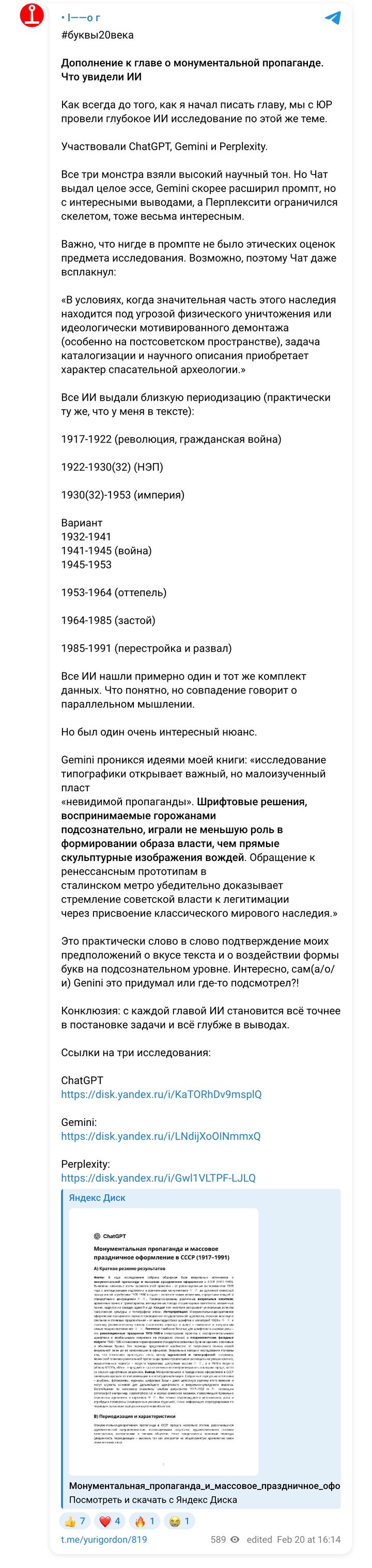
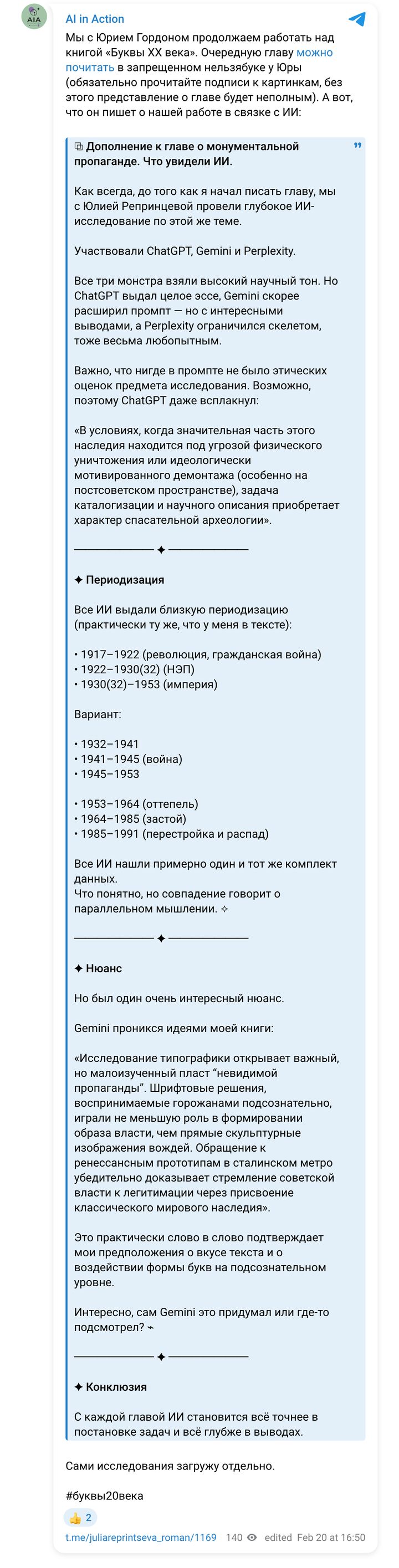
Yuri Gordon and I — about this work in our own channels (in Russian). Each post links to the original.