The book “Letters of the 20th Century” · August — September 2025 · research 03
Letters of the Moscow Metro, 1935–1953
Task
Analyse the Metro’s inscriptions in seven groups — façades, platforms, wayfinding, memorial, technical, carriages, temporary; define the style, trace its changes, read the texts for content.
What was done
The prompt was built to OpenAI’s requirements for GPT-5: goal, input data, quality criteria, format, verification. Perplexity found 245 sources; GPT-5 wrote a 13-page essay with a classification and caveats on dating — and proposed checks of its own that were not in the brief.
Tools
Perplexity, ChatGPT GPT-5 Deep Research
Where to look
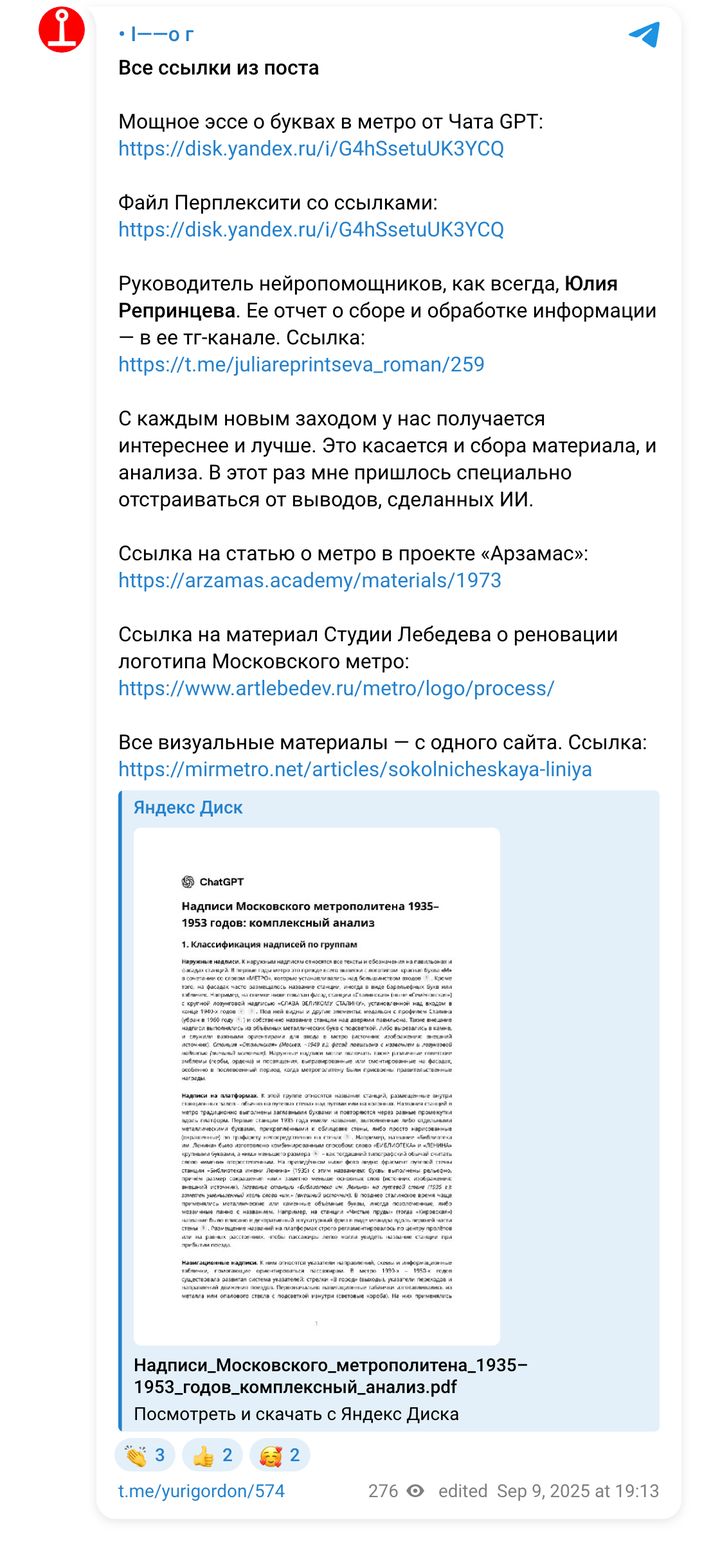
Below are the briefs the models received, the finished reports in PDF and the documents, as well as the publications made along the way.
Briefs
What exactly the model received
Deep Research brief: Moscow Metro inscriptions
My document · the text the model received · 29 August 2025
Research goal
Carry out a comprehensive analysis of the inscriptions of the Moscow Metro in the period 1935–1953 by group, stylistic change and ideological content, drawing on the links from the provided document of links (attached by the user), and bringing in additional authoritative sources for verification.
Geography and period
- Geography: USSR → Moscow (Moscow Metro).
- Period: 1935–1953 (the launch of the Metro — the early Stalin period; the war years; post-war “high Stalinism” up to 1953).
Input data
- Main input: the user’s document with links to images/pages with photographs and scans of inscriptions (file name and format — see the attachment in the chat).
- Additional sources (to check dates/authenticity): official and museum publications, archive photos, catalogues of station reconstructions, specialist publications on architecture/type.
In the report, mark explicitly which examples are taken from the user’s document and which from additional sources.
Research tasks
1) Classification by group (continuous text with clickable links)
Split the examples found into groups and for each group output as one continuous paragraph: Group name: a list of links to images/pages (comma-separated). The list of groups:
- Exterior inscriptions
- Platform inscriptions
- Wayfinding inscriptions
- Memorial inscriptions
- Technical inscriptions
- Inscriptions on and inside carriages
- Temporary and incidental inscriptions
Requirements:
- Links must lead to pages with images (or to the images themselves). If the source is an article but it contains photos, give a direct link to the block with the photo/scan.
- If one image fits several groups at once, keep it in the priority group and add a cross-reference (“see also …”).
2) Stylistic analysis and its dynamics (for each group)
For each group describe the evolution of style in 1935–1953:
- Typography and letterforms: serif/sans serif, weight, contrast, character of proportions, capitals/lower case, letter spacing.
- Materials and technique: enamel/metal/stone/mosaic/glass/neon; method of application (applied letters, painting, stencil, cast/stamped elements).
- Colour and decoration: palette, frames, borders, boards, plaques.
- Composition and placement: mounting height, zones of the station/vestibule/passages/carriages, plaque formats.
- Dates and phases: identify the key sub-periods (e.g. 1935–1938, 1939–1945, 1946–1953) and describe the shifts (simplification/elaboration, the move from “constructive” austerity to “imperial” representativeness, etc.).
- Attribution (if possible): station architects, workshops, agencies, standards and circulars that affected uniformity.
3) Ideology and propaganda (content analysis)
Analyse the content formulas and rhetoric of the inscriptions:
- Slogans, mottos, dedications, mentions of state institutions, coats of arms/emblems/symbols, names of leaders, place names and titles that reflect the ideology.
- How the tone and semantics changed (patriotism, mobilisation, the cult, victory, post-war representation, “the people’s spirit”, “the heroism of labour”).
- Where the ideology shows explicitly (slogans, bas-relief inscriptions) and where implicitly (the typography of power, ceremonial formats, scale and placement, “the language of representation”).
- Compare with the historical stages (pre-war/war/post-war period) and tie them to datable examples from the links.
Quality control and verification
- Weed out post-Soviet restorations/replacements: check dating against archive photos, publications, museum descriptions. If an object has been reconstructed, note it.
- If the date of an example is not obvious, use indirect signs (material, typeface, plaque construction) and mark the dating as an estimate (“approximately 1946–1949”).
- For each claim about style/ideology give 1–2 links to supporting examples (including links from the user’s document).
Output format (strict)
Output as a single document in Russian in this order:
- Classification by group — as continuous text: — for each of the 7 groups, one paragraph: “\[Group name]: link1, link2, …”.
- Stylistic analysis by group (subheadings are allowed, but the text is continuous, no lists).
- Ideology and propaganda (continuous text with links to examples).
- Short conclusions (5–7 sentences): what is characteristic of 1935–1953, how the groups differ, where the ideology is strongest.
Insert links inline (not as footnotes) so they can be clicked. Do not use tables. Language — strictly Russian.
Definition of done
- All 7 groups are present; each has a list of working links to images.
- Each group has stylistic dynamics tied to sub-periods.
- The ideological analysis rests on specific examples from the links.
- Reconstructions/modern replacements are clearly marked (if any).
Results
Reports and documents
Perplexity report and a collection of 245 sources
Project document · 29 August 2025
Entrance signs and logos
From its opening in 1935 the main sign of the Moscow Metro was a red letter “M” with distinctive serifs. Illuminated “METRO” signs were placed over the entrances; the word was originally masculine in Russian, which is why Soviet posters read “Our Metro is the best in the world!” with the masculine form.
Official station names
The original 1935 names: “Dzerzhinskaya” (now “Lubyanka”); “Dvorets Sovetov” (Palace of Soviets, now “Kropotkinskaya”); “Kirovskaya” (now “Chistye Prudy”); “Ploshchad Sverdlova” (Sverdlov Square, now “Teatralnaya”).
Wartime memorial plaque: at the seven stations built in 1941–1945, memorial plaques reading “Built in the days of the Patriotic War” were installed: “Novokuznetskaya”, “Paveletskaya”, “Avtozavodskaya”, “Semyonovskaya”, “Baumanskaya”, “Elektrozavodskaya”, “Partizanskaya”.
Mosaic inscriptions and panels
- “Mayakovskaya” (1938) — A.A. Deineka’s mosaic cycle “A Day of the Soviet Sky”, 34 panels; made in V.A. Frolov’s workshop in besieged Leningrad.
- “Komsomolskaya” radial (1935) — column capitals with the bronze emblem of the KIM (Communist Youth International); E.E. Lanceray’s panel “Metro Builders”.
- “Novokuznetskaya” (1943) — V.A. Frolov’s mosaics: gardeners, steelworkers, builders, aviators; also from besieged Leningrad.
Political inscriptions and slogans
- The anthem of the USSR at “Kurskaya” on the Circle line (1950): “Through storms the sun of freedom shone on us, / And great Lenin lit our path. / Stalin raised us to be true to the people, / He inspired us to labour and to feats!”
- “Kiyevskaya” on the Circle line (1954) — inscriptions about “the Party congress — a congress of the unity of the Party, the government and the people”, and “order-bearing Ukraine, the republic of workers and peasants”.
Wayfinding inscriptions
“To the trains”, “To the city”, “Stand on the right, walk on the left”.
Agitation materials
“All of Moscow is building the Metro” (1934); “Our cause is just — we shall win” (wartime); “Soviet means excellent!” (1950s advertising).
Special wartime inscriptions
“To the great, dear Stalin, initiator and inspirer of the Metro’s construction — proletarian greetings” (“Sokolniki”); “Glory to the partisans, men and women”. Badge “L.M. Kaganovich Metro”, 1935.
The Moscow Metro of 1935–1953 was not only a transport system but also a large-scale ideological platform, where every inscription, mosaic and slogan carried an important load of meaning.
Collection of links — 245 sources (the full list from the document)
- link
- link
- link
- link)
- link
- link
- link
- link)
- link
- link
- link
- link
- link
- link
- link
- link
- link
- link
- link
- link)
- link
- link
- link
- link
- link
- link
- link
- link
- link
- link
- link
- link
- link
- link
- link
- link
- link
- link
- link
- link
- link
- link
- link
- link
- link
- link
- link
- link
- link
- link
- link
- link
- link
- link)
- link
- link
- link
- link
- link
- link
- link
- link
- link
- link
- link
- link
- link
- link
- link
- link
- link
- link
- link
- link)
- link
- link
- link
- link
- link
- link
- link
- link
- link
- link
- link
- link)
- link
- link
- link
- link
- link
- link
- link
- link
- link
- link
- link
- link
- link
- link
- link
- link
- link
- link
- link
- link
- link
- link)
- link
- link
- link
- link
- link
- link
- link
- link
- link
- link
- link)5-271/2877
- link
- link
- link
- link)
- link
- link
- link
- link
- link
- link
- link
- link
- link
- link
- link
- link
- link
- link
- link
- link
- link
- link
- link
- link
- link
- link
- link)
- link
- link
- link
- link
- link
- link
- link
- link
- link
- link)
- link
- link
- link
- link
- link)
- link
- link
- link
- link
- link
- link
- link
- link
- link
- link
- link
- link
- link
- link
- link
- link (Lavrentyev A.N., History of Design, PDF)
- link
- link
- link)
- link
- link
- link
- link
- link
- link
- link
- link
- link)
- link
- link
- link
- link
- link)
- link
- link
- link
- link
- link
- link
- link
- link
- link
- link
- link
- link (PDF)
- link
- link
- link
- link)
- link
- link
- link
- link
- link
- link
- link
- link
- link
- link
- link
- link
- link
- link
- link
- link
- link
- link
- link
- link
- link
- link
- link
- link
- link
- link
- link
- link
- link
- link
- link
- link
- link
- link
- link
Publications
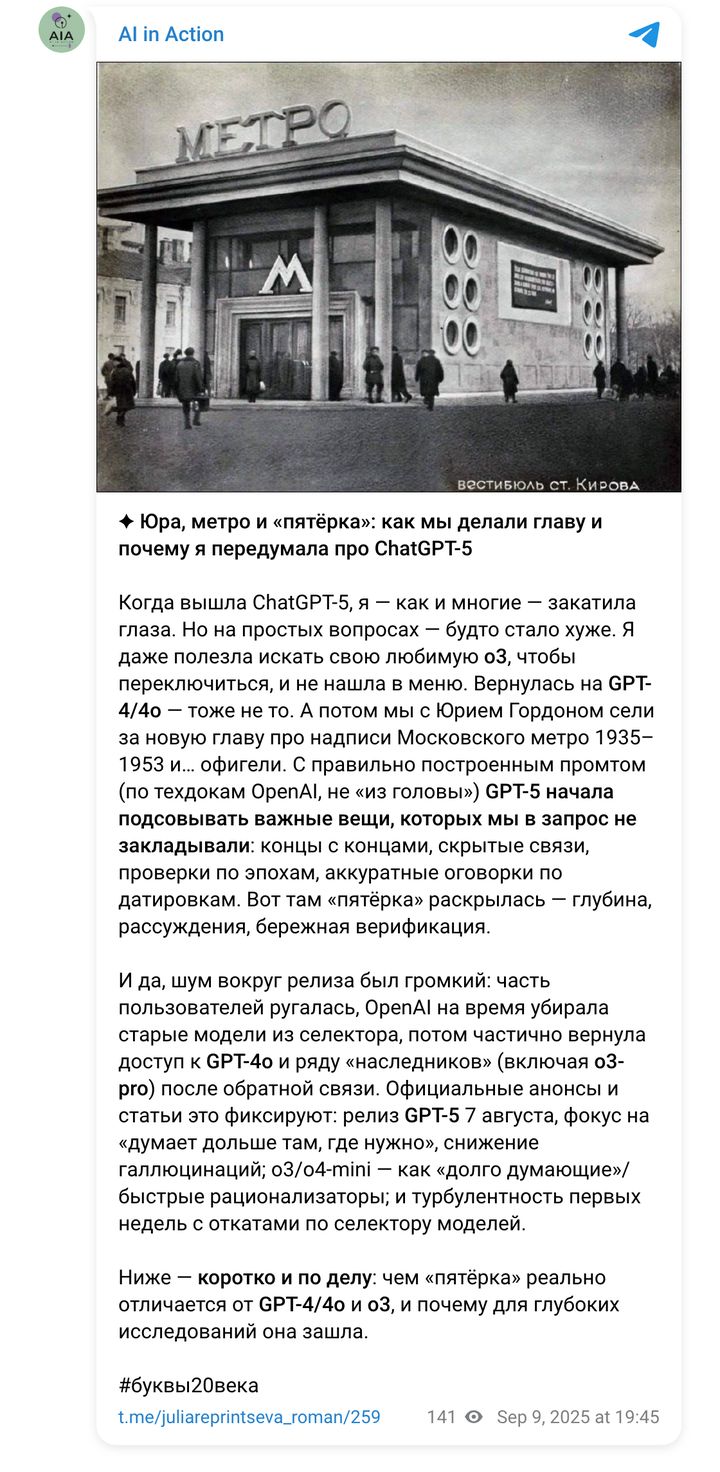
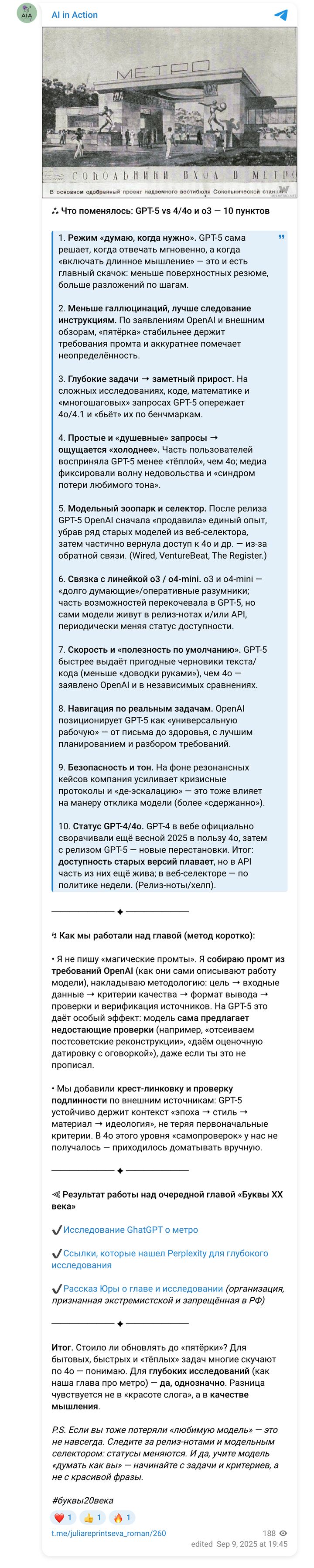
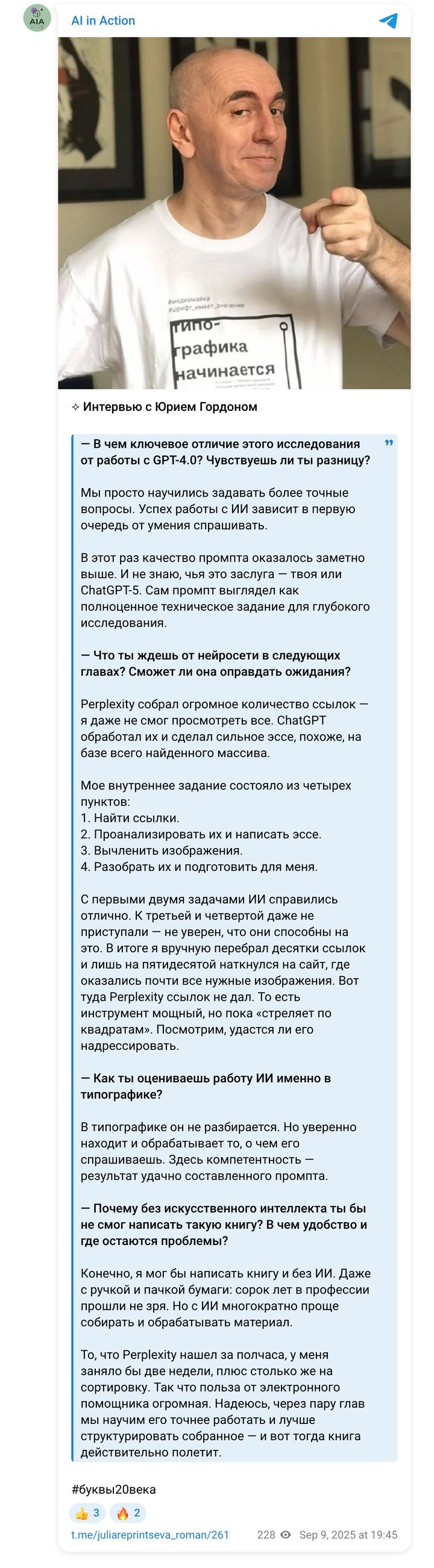
Posts about this research
Yuri Gordon and I — about this work in our own channels (in Russian). Each post links to the original.